

Step-by-Step: How to Rent Your First Apartment in Barcelona (Complete 2025 Guide)
Renting your first apartment in Barcelona can feel overwhelming — especially if you're new to Spain, searching from abroad, or navigating a fast-moving market for the first time. You're facing tight timelines, unfamiliar contracts, document requirements you've never heard of, and competition from dozens of other applicants. But once you understand the process and follow a clear plan, finding a great flat becomes much simpler.
This guide walks you through every step, from preparation to move-in day. By the end, you'll know exactly what to do, when to do it, and how to avoid the mistakes that slow down most first-time renters.
Why Renting in Barcelona Feels Complicated (But Doesn't Have to Be)
Barcelona is one of Europe's most in-demand cities for locals, expats, students, digital nomads, and remote workers. This popularity creates real challenges:
- Flats disappear extremely quickly. A good listing can receive 50+ inquiries within minutes of being posted. Agents move fast, and if you're slow, you lose the opportunity.
- Agents prioritize prepared renters. If your documents aren't ready or your application is incomplete, they skip you and move to the next candidate. It's not personal — there are simply too many options.
- Listings are scattered across 10+ platforms. Each website has different properties. Idealista has listings that aren't on Fotocasa. Badi has rooms that aren't on Habitaclia. Spotahome has mid-term options nowhere else. Manually checking each site multiple times per day is inefficient.
- Many newcomers don't understand the system. Contract types vary wildly. Deposit requirements differ. Some buildings have strict rules. Scams exist. And if you're renting from abroad, everything feels more complex.
The good news? With a step-by-step system and the right tools, renting your first Barcelona apartment becomes manageable — even straightforward. Thousands of first-time renters do it successfully every month.
Step 1: Understand How Renting Works in Barcelona
Before you start searching, it's critical to understand the basics of the Barcelona rental market. This foundation will help you make better decisions and avoid confusion later.
The Market Is Fast and Competitive
The Barcelona rental market moves quickly because supply is limited and demand is high. Properties receive multiple inquiries within hours. Landlords and agents know that if they don't act fast, they might lose a tenant to someone with a faster application.
This means speed matters. You need to:
- See listings as soon as they're posted (within minutes, ideally)
- Contact agents or landlords immediately
- Have your documents prepared in advance
- Be ready to view within 24 hours
- Apply the same day if you're interested
Manual scrolling through websites at random times means you'll always arrive late to the best opportunities.
Three Main Rental Types in Barcelona
Long-Term Rentals ("Vivienda Habitual")
These are standard residential rental contracts designed for people who will make Barcelona their home.
Key characteristics:
- Minimum contract length of 1 year (often 5 years by default in Barcelona)
- Legally regulated rent increases
- More tenant protections under Spanish law
- Typically unfurnished (you arrange furniture yourself)
- More documentation required from the renter
- Landlords are often professional agencies or companies
- Better for stability and long-term planning
Best for: People relocating to Barcelona for work, families, or anyone planning to stay 2+ years.
Learn more about long-term contracts: our guide on what-is-contrato-arrendamiento
Mid-Term Rentals (32 Days to 11 Months)
These flexible contracts bridge the gap between short-term tourism and long-term living.
Key characteristics:
- Contract duration between 32 days and 11 months
- Fully furnished apartments (beds, kitchen, furniture included)
- More flexible terms, fewer legal protections than long-term
- Higher price per month (typically 20-40% more than long-term)
- Designed for expats, digital nomads, students, and temporary workers
- Faster application process
- Fewer documents typically required
Best for: Digital nomads, students on semester programs, people relocating to Barcelona temporarily, or anyone unsure about long-term commitment.
Learn more: our guide on short-term-rentals-barcelona-legal
Rooms in Shared Flats
If budget is tight or you want community, shared flats are a popular option.
Key characteristics:
- You rent one bedroom in a multi-bedroom apartment
- Other rooms occupied by other renters or the landlord
- Student-friendly and social
- Often furnished
- Faster response times from landlords
- More affordable than entire apartments
- Available on Badi, Idealista, Facebook groups, and other platforms
- Shared expenses (internet, utilities) split among residents
Best for: Students, budget-conscious renters, people who enjoy shared living, newcomers who want community.
Furnished vs. Unfurnished: What's the Difference?
Long-term unfurnished apartments are the default in Barcelona. This means:
- The apartment comes empty (no furniture, sometimes no kitchen cabinets)
- You must buy or rent furniture yourself
- More affordable monthly rent
- More personal freedom to decorate
- Usually requires longer commitment (1-5 years)
Mid-term furnished apartments come ready to live in:
- Bed, sofa, dining table, kitchen equipment included
- You move in with just your suitcase
- Higher monthly rent
- No time spent shopping for furniture
- Perfect if you're unsure about staying long-term
Understanding this distinction helps you budget correctly and set realistic expectations.
Step 2: Define Exactly What You're Looking For
This step dramatically speeds up your search. The more specific you are, the fewer apartments you'll need to consider, and the faster you'll find the right fit.
Choose Your Neighborhood
Barcelona's neighborhoods have distinct personalities and practical considerations. Here are the most popular areas for first-time renters:
Poblenou — Beach access, coworking spaces, vibrant expat community, trendy bars and restaurants. Popular with digital nomads and young professionals.
Eixample — Central location, safe, beautiful modernist architecture, excellent metro connections, good restaurants. Popular with professionals and established expats. More expensive.
Gràcia — Local, charming, lively, strong community feel, independent shops and bars, younger vibe. Popular with students and bohemian professionals. Less touristy than Born.
Sants — Well-connected by metro, more affordable than central areas, residential feel, local atmosphere, quieter than Eixample. Good for budget-conscious renters.
Born / Gòtic — Historic, central, excellent nightlife, near waterfront, but very touristy and expensive. Better for short-term rentals.
Diagonal Mar / Vila Olímpica — Modern, beachside, cleaner and newer than old city, great for those who want a quieter beach vibe. Less character than central areas.
Pro tip: Visit each neighborhood at different times of day to get a feel for it. What's charming on Saturday evening might be loud at 2 AM.
For detailed neighborhood breakdowns: our guide on best-neighborhoods-rent-barcelona and our guide on best-neighborhoods-to-rent-in-barcelona-complete-2026-breakdown
Set Your Monthly Budget (All Costs)
Most first-time renters only think about rent, but your actual monthly housing cost includes much more:
Rent — The apartment price listed on websites.
Utilities ("gastos") — Community fees, sometimes including water, sometimes not. Typically €50-150/month depending on building size and included services. Always ask what's included.
Internet — €30-50/month for decent broadband. Sometimes included in mid-term furnished rentals.
Electricity and gas — Not always included in utilities. Budget €50-100/month in winter, €20-40/month in summer. Varies hugely based on heating/cooling usage.
Phone/mobile — €15-30/month if you don't already have a plan.
Total budget example:
- Rent: €750
- Gastos: €80
- Internet: €40
- Utilities (est.): €60
- Total: €930/month
Typical ranges by area:
- Budget-friendly (Sants, Poblenou outer): €600-850/month
- Mid-range (Gràcia, Eixample outer): €800-1,200/month
- Premium (Eixample central, Born): €1,200-2,000+/month
Learn more: our guide on how-much-cost-rent-barcelona
Choose Your Rental Type
Now that you understand the three types, decide which fits you:
- Entire apartment (long-term unfurnished) — Most control, best long-term value, but requires furniture setup and longer commitment.
- Entire apartment (mid-term furnished) — Instant move-in, perfect if you don't know how long you're staying, but more expensive.
- Private room in shared flat — Most affordable, social, fastest application process, but less privacy.
Decide Your Move-In Date
When are you planning to move? This matters more than you think.
Agents strongly prefer renters who can move within 7-14 days. It shows you're serious and already planning ahead. If you say "I'm looking for something starting in 6 months," agents deprioritize you.
If you don't have an exact date, pick a realistic one: "I need to move by March 15" is better than "sometime in spring."
Learn more about timing: our guide on the-best-time-to-look-for-rentals-in-barcelona-2025-guide
Step 3: Gather Your Documents Before You Search
This is one of the most critical steps. If your documents aren't ready, agents simply skip you. Period.
Most first-time renters make the mistake of searching first and gathering documents later. That's backward. Have everything prepared before you contact anyone. You'll be amazed at how much faster the process moves.
Required Documents for EU Citizens
- Passport or National ID — Required for any rental agreement
- Proof of income — Either 3 recent payslips OR a signed work contract from your employer. Both ideally.
- Bank statements — Optional but helpful (last 2-3 months showing account balance and incoming deposits)
- Employer letter — Optional. A letter on company letterhead confirming employment, your role, and annual salary. Strengthens your application.
Required Documents for Non-EU Citizens
- Passport — Always required
- Work contract or employment letter — Proof that you'll have income to pay rent. For remote workers, a letter from your employer confirming your position and salary.
- Visa documentation — Copy of your visa pages
- Bank statements — Proof of savings/funds (2-3 months)
- NIE — Spanish tax identification number. Technically optional at first application, but helpful.
Can You Rent Without a NIE?
Yes, absolutely. Many landlords and agencies accept:
- Passport
- Employment contract
- Higher deposit amount (to compensate for less verified identification)
- Guarantee letter or reference from previous landlords (if applicable)
Your NIE can be obtained after you move in and are registered at the address. It's not a blocker.
Learn more: our guide on nie-number-barcelona-renting
Pro Tip: Create a Rental Application Package
Here's what sets successful renters apart: Put all your documents together in a single, well-organized PDF, along with a brief introduction about yourself.
Your package should include (in this order):
- A brief cover letter (3-4 sentences about yourself, why you're moving to Barcelona, your move-in date)
- Passport or ID (main pages)
- Work contract (front and back)
- Recent payslips (3 months)
- Bank statements (2-3 months)
- Employer letter (if available)
Name the file clearly: YourName_RentalApplication_2026.pdf
When you contact an agent, you can immediately say: "I'm very interested in this apartment. I've attached my complete rental application with all documents ready. I can move quickly."
This positions you as the ideal renter — organized, serious, and low-friction. It makes agents want to work with you over the 20 other applicants who are disorganized.
Step 4: Start Your Search the Smart Way
Here's where most first-time renters make their biggest mistake.
Why Manual Searching Fails
They rely on manually refreshing one or two websites several times per day. This approach fails because:
- Listings are spread across 10+ platforms: Idealista, Fotocasa, Habitaclia, Pisos.com, Badi, Spotahome, HousingAnywhere, Uniplaces, Yaencontre, Facebook groups, WhatsApp groups, and more.
- You'll always be late: By the time you see something, 50 other people have already contacted the agent. The decision is already made.
- You'll miss good opportunities: Some landlords only list on one platform. If you only check Idealista, you miss everything on Fotocasa.
- You waste hours every day: Refreshing websites is mindless and unproductive.
- You'll lose momentum: After day 3 of this, you'll get discouraged and give up.
The Fast Method: Use an Aggregator + Instant Alerts
The solution is simple: use a search tool that pulls from all platforms and sends you instant alerts.
CasaRadar collects apartments from all major platforms and sends instant notifications when new listings match your criteria. This approach gives you a massive advantage:
✔ Search once — Define your criteria (neighborhood, budget, size, rental type) one time in CasaRadar.
✔ Set alerts — Instant notifications the moment a new apartment matches your search. You'll know about it before most people refresh their browser.
✔ Be first to contact — You have a 10-minute window before competitors see the listing. Use it.
✔ Save hours every day — No more refreshing websites. The alerts come to you.
Compare different platforms: our guide on idealista-vs-fotocasa-vs-casaradar
Learn about alerts: our guide on barcelona-house-and-room-rental-alerts-get-instant-notifications-from-all-major-and-small-housing-platforms
Step 5: Message Agents and Landlords the Right Way
When you find an apartment that interests you, your message will be one of dozens (or hundreds) the agent receives that day.
Most messages are generic, low-effort, and forgettable: "Is this available?" or "I'm interested."
Your message needs to stand out. Here's a template that works:
Message Template (English)
Subject: Interested in the apartment in [Neighborhood] — [Your Name]
Hello,
My name is [Your Full Name] and I'm relocating to Barcelona in [month]. I'm moving for [work/studies/remote job], and I'm very interested in this apartment.
I can view the apartment at your earliest convenience — ideally this week. I have all my documents prepared and can move quickly if we agree on terms.
I've attached my complete rental application with all required documents. Please let me know the next available viewing time.
Thank you for your time.
[Your Full Name][Your Phone Number][Your Email]
Message Template (Spanish)
Asunto: Interesado en el piso en [Barrio] — [Tu Nombre]
Hola,
Mi nombre es [Tu Nombre Completo] y me mudo a Barcelona en [mes]. Me cambio para [trabajo/estudios/trabajo remoto], y estoy muy interesado/a en este piso.
Puedo visitarlo cuando sea conveniente para usted — preferiblemente esta semana. Tengo todos mis documentos preparados y puedo mudarme rápidamente si llegamos a un acuerdo.
He adjuntado mi solicitud completa de arrendamiento con todos los documentos requeridos. Por favor, avíseme la próxima vez disponible para visitar.
Gracias por su tiempo.
[Tu Nombre Completo][Tu Teléfono][Tu Email]
Tips to Maximize Your Reply Rate
- Send immediately. Within 5 minutes of seeing the listing is ideal. Every minute counts.
- Be polite and professional. Use formal language. This isn't a text to a friend.
- Confirm document readiness. "All documents prepared" signals you're serious.
- Mention flexibility. "I can visit today or tomorrow" removes friction from the agent's perspective.
- Include phone number. Agents often prefer to call. Make it easy.
- Keep it concise. 3-4 short paragraphs. Long messages get skimmed or ignored.
- Attach your application package. Send that PDF with all your documents.
Step 6: Book Viewings Immediately
Once the agent responds and offers viewing times, book immediately. If you wait even one day, the apartment might be rented to someone else.
Ideally, view within 24 hours of first contact.
What to Check During a Viewing
Don't just look at the furniture and paint color. First-time renters often miss practical issues that create problems later. Here's what to actually inspect:
Water pressure and water temperature — Run all taps. Test hot water from the shower. Weak pressure is a sign of old pipes or building issues.
Natural light — Visit at the same time of day you'll actually be home. An apartment that looks bright at noon might be dark at 6 PM.
Internet options — Ask which providers service the building. What speeds are available? Some older buildings have limited options.
Mold and humidity — Open the closet doors and check corners. Barcelona's humidity is real, and mold is common in older apartments, especially in kitchens and bathrooms. This is a dealbreaker for many people.
Noise levels — Open the windows. Is there street noise? Traffic? Bars below? Visit evening if possible to hear late-night activity.
Heating and air conditioning — Many Barcelona apartments only have AC and no heating. Ask what's available and if it works. Test both.
Building elevator — Is there one? How old? Does it actually work? Walking up six flights every day is less romantic than it sounds.
Contract details — Ask about lease length, renewal terms, notice period, and exactly what's included in utilities.
Inclusive expenses ("gastos") — What does this cover? Water? Trash? Maintenance? Sometimes it's just community fees; sometimes it includes more.
Pet policy — If relevant to you, confirm in writing.
Smoking policy — Important if you or neighbors smoke.
If You're Viewing Remotely (From Abroad)
Many agencies now offer:
- Video tours — Live or recorded walkthrough via WhatsApp, Zoom, or email
- Virtual viewings — 360° apartment photos or virtual tours
- Reference checks — Ask if you can speak with current or previous tenants
- Digital contracts — Some agencies handle everything digitally, including signing
Don't rush this process just because you're remote. Ask detailed questions, request multiple angles of rooms, and confirm everything in writing before committing.
Step 7: Apply for the Apartment
If you like the apartment after viewing, apply the same day. Don't sleep on it. Good apartments have multiple applications coming in constantly.
Your application should include:
- Passport or ID — Copy of main pages
- Employment proof — Work contract or 3 recent payslips
- Bank statements — 2-3 recent months
- Completed application form — If the agency provides one
- References — Previous landlord references if you have them (extremely helpful)
How Much Money Do You Need?
Budget these amounts upfront:
- Deposit (fianza): 1-2 months' rent (always refundable at end of lease)
- First month's rent: Full month's rent, due upon signing
- Agency fee: Usually 0.5-1 month's rent (varies, sometimes paid by landlord, sometimes by you)
Example for a €750/month apartment:
- Deposit: €750-1,500
- First month's rent: €750
- Agency fee: €375-750
- Total upfront cost: €1,875-3,000
Most landlords and agencies want this in place before you sign. Have it available in your Spanish bank account (you can open one within 24 hours if you don't have one).
Increase Your Acceptance Chances
- Send all documents immediately — Same day, not "I'll send them tomorrow"
- Confirm immediate availability — Say you can sign within 2-3 days if needed
- Be responsive — Answer all follow-up questions quickly
- Provide references — If possible, contact from previous landlords or employers
- Propose a slightly higher deposit — If your background is atypical, offering 2 months instead of 1 shows good faith
Step 8: Understand Your Contract Before Signing
Never sign a contract you don't understand. This is your legal protection.
Barcelona has two common rental contract types:
Long-Term Contract (Vivienda Habitual)
- Default length: 5 years (if the landlord is a person, not a company)
- Renewal: Automatic unless either party gives notice
- Rent increases: Regulated by Spanish law (usually 2-3% annually)
- Tenant protections: Strong — Spanish rental law heavily favors long-term tenants
- Notice period: Usually 30 days to terminate
What this means for you: Your rent is more stable and predictable. You have legal protections if things go wrong. But you're also committed for a long period.
Mid-Term Contract (Temporada)
- Length: 32 days to 11 months (you choose, usually 3-6 months)
- Renewal: Only if both parties agree (no automatic renewal)
- Rent: Typically higher than long-term (20-40% premium)
- Tenant protections: Fewer than long-term
- Notice period: Usually 30 days
What this means for you: Maximum flexibility. You can leave without major penalty. But rent is higher and you'll need to find new housing at the end.
Critical Things to Check in Your Contract
Before you sign, verify these details in writing:
- Full address of the apartment — Obvious, but confirm it matches
- Contract start date — When does liability transfer?
- Contract end date — When does the lease expire?
- Monthly rent amount — Should match your offer
- Deposit amount — How much are you paying? (Should be 1-2 months)
- What's included in "gastos" — Water? Trash? Community fees? List it all
- Utility responsibility — Who pays for electricity, gas, internet? (Usually renter)
- Notice period — How long to give notice before leaving?
- Renewal terms — How does it renew after initial term?
- Inventory list — Detailed list of furniture/items in the apartment. Critical for mid-term furnished rentals. Take photos of everything.
- Cancellation terms — What happens if you need to leave early?
- Maintenance responsibility — Who fixes what? (Landlord usually covers structural; you cover appliances)
Red Flags — Don't Sign If You See These
- No address listed — How can you have a contract for a location that's not specified?
- Handwritten contract — Professional agreements are always typed. Handwritten is a sign of an informal/unregulated arrangement.
- Vague terms — If something says "approximately €750" or "we'll decide later," walk away.
- Terms don't match your conversation — If you agreed to €800 and the contract says €900, don't sign.
- Missing signatures or dates — Unsigned contracts aren't valid.
- Demand for cash payment — Professional landlords use bank transfers. Cash is a red flag for tax evasion or worse.
What to Do Before Signing
- Read it completely — Every paragraph. Use Google Translate if you don't speak Spanish.
- Check all numbers — Rent, deposit, dates, utilities amounts.
- Compare to your agreement — Does the contract match what was promised?
- Ask about unclear terms — Email the agent with questions. Get written answers before you sign.
- Have a friend review it — Get a second set of eyes, ideally someone who speaks Spanish.
- Keep a copy — Once signed, request a fully executed copy (both sides' signatures).
Step 9: Move-In Steps (Don't Skip These)
Signing is done, but you're not finished. The move-in process involves several important steps that protect your rights and set you up for success.
Transfer Utilities
Check which utilities are already included in your "gastos" (community fees):
- Electricity — Usually your responsibility. Call Endesa, Iberdrola, or other providers and register the account in your name.
- Gas — If not included in gastos. Register with the provider (usually Naturgy or similar).
- Water — Sometimes included, sometimes not. Ask your landlord.
- Internet — Your choice. Movistar, Orange, Vodafone, Lowi, Digi, and others compete for business. Shop around.
Most providers let you switch online or via phone. Have your NIE or passport handy.
Complete Empadronamiento (Official Registration)
This is your official registration as a Barcelona resident. This is important, not optional.
You'll need this for:
- Healthcare access (registering with a doctor)
- Residency documents
- Tax purposes
- Bank accounts and official ID
Visit your local civic center (Oficina de Atención Ciudadana) with:
- Your passport
- Your new address
- A copy of your rental contract
Learn more: our guide on what-is-empadronamiento-barcelona
Photograph the Inventory List
Take detailed photos of every room, every closet, and every item listed in the inventory. This protects you when you move out.
Critical for furnished apartments: Document the condition of furniture, appliances, and walls. A small mark now won't become your financial liability later.
Create a shared document with the landlord if possible, confirming the condition.
Set Up Internet
You'll want internet from day one. Different providers offer different speeds and prices. Popular options:
- Movistar — Widespread, reliable, slightly pricier
- Orange — Good coverage, competitive pricing
- Vodafone — Similar to Orange
- Lowi — Budget option, decent speeds
- Digi — Competitive, often good deals
Shop online or ask neighbors for recommendations. Installation usually takes 3-5 days after ordering.
Understand Building Rules
Every building has rules. Ask your landlord or building manager about:
- Quiet hours — Usually 10 PM-8 AM (strictly enforced in Barcelona)
- Trash collection — Where are bins? When are they collected? How to sort waste?
- Parking — Is there parking? Cost? Rules?
- Elevator access — Any restrictions or maintenance?
- Hallway/common areas — Rules for keeping them clean?
- Guest policy — Can guests stay overnight? Any restrictions?
Violating these can result in complaints, fines, or even eviction in extreme cases.
Step 10: Common Mistakes First-Time Renters Make
Learn from the thousands who've come before you. Avoid these mistakes:
Waiting Too Long to Apply
If you like the apartment, apply the same day. Don't think about it overnight. Don't comparison shop first. Apply immediately, then continue looking if you want. You can always decline if something better comes along.
Not Having Documents Ready
This is the #1 reason first-time renters lose out. You see an apartment, contact the agent, they ask for documents, and you say "I'll send them tomorrow." By then, they've already accepted another application.
Always have your documents prepared before you start searching.
Searching Manually on One Website
Spending 30 minutes a day refreshing Idealista won't work. You'll miss 80% of available apartments and always arrive too late. Use an aggregator with alerts instead.
Paying Before You Visit
Scams exist. Never send money without seeing the apartment in person. No exceptions. Any landlord asking for money before a viewing is not legitimate.
Learn more: our guide on avoid-rental-scams-barcelona
Asking for Discounts Immediately
Barcelona is a landlord's market. Vacancy rates are low, competition is high. Don't ask for rent discounts during the application phase. You'll just be rejected and replaced. Wait at least 6-12 months, then propose a modest reduction for lease renewal.
Not Checking Humidity or Heating Systems
Barcelona is humid, especially near the coast and in older buildings. Mold and moisture are common issues. Check for these during viewings.
Similarly, many apartments don't have central heating — only AC. If you're moving in winter, confirm heating exists and works. Barcelona rarely gets that cold, but when it does, an unheated apartment is miserable.
Ignoring Contract Details
Don't just skim your contract. Red flags in unclear terms can cost you thousands in disputes later. Spend 30 minutes reading and understanding every paragraph.
Committing Too Early Without Exploring Neighborhoods
You found one apartment and immediately applied. But you haven't actually spent time in that neighborhood. Visit at different times of day. Walk around. Eat at local cafes. Make sure you actually like the area before committing to a year-long lease.
Ready to Find Your First Barcelona Apartment?
You now have a complete roadmap. The process is straightforward once you understand the steps:
- Know what type of rental you want
- Prepare your documents immediately
- Search smart using tools that show you everything
- Act fast when you find something
- Check your contract carefully
- Move in, register, and enjoy your new home

Ready to Find Your Rental Place in Barcelona?
Frequently Asked Questions About Renting your First Apartment in Barcelona
Here are answers to some of the most common questions we receive.
How long does it actually take to rent your first apartment in Barcelona?
Timeline varies, but here's realistic: 2-4 weeks from start to signing, assuming you have your documents ready and can view apartments quickly. - Week 1: Prepare documents, set up alerts, contact initial apartments - Week 2-3: View multiple apartments, apply for your top choice - Week 4: Sign contract, arrange utilities, move in If you're disorganized or searching from abroad, add 2-3 weeks. If you're willing to accept the first apartment that fits your criteria, you could do it in 5-7 days. The variable isn't how long apartments take to rent — it's how picky you are about location and condition.
Can I rent in Barcelona without speaking Spanish?
Absolutely. Most real estate agents in Barcelona speak English, especially agents working with expats. Many rental websites (Idealista, Spotahome, HousingAnywhere) have English interfaces. However, your contract will likely be in Spanish. Use Google Translate or hire a translator to review it (€50-100 one-time investment). Building managers might not speak English, so learning basic Spanish phrases helps.
What is the minimum deposit required when renting in Barcelona?
The standard deposit is 1 month's rent, though some landlords ask for 2 months, especially if you're a non-EU citizen or have limited rental history. This is a refundable deposit — you get it back (minus any damage) when you move out. Learn more:
Do I need a guarantor as a first-time renter?
Not always, but it helps. If you don't have a guarantor, you can: - Offer a higher deposit (2 months instead of 1) - Provide strong bank statements showing savings - Get an employment letter from your employer confirming your salary - Ask a friend or family member to serve as guarantor (they guarantee payment if you default) Many Barcelona landlords don't require guarantors from employed renters with decent bank statements.
Can I rent an apartment in Barcelona from abroad before I arrive?
Yes, but it's risky and requires trust. Options: - Video tours + digital contracts — Some agencies handle everything online, including signing with digital signatures - Temporary accommodation first — Arrive, stay in an Airbnb for 2 weeks, view apartments in person, then sign once you're there - Trusted agent — Use reputable agencies like CasaRadar that verify listings and protect renters - Bank transfer deposit — Only send money to an official bank account in the landlord's or agency's name Never send money via Western Union or other untraceable methods. If a landlord insists, it's a scam.
What if I can't find anything — should I take a temporary place first?
Many renters do exactly this and it works well: 1. Arrive in Barcelona and book an Airbnb or Airbnb-style rental for 2-4 weeks 2. Once you're there, search for permanent housing in person 3. View apartments, get a feel for neighborhoods, build local connections 4. Find a great apartment and move in Pros: You see apartments in person, avoid scams, get a feel for the city Cons: You pay twice (Airbnb + permanent deposit), adds 2-4 weeks to timeline This approach is worth it if you're very cautious or moving from far away. ---
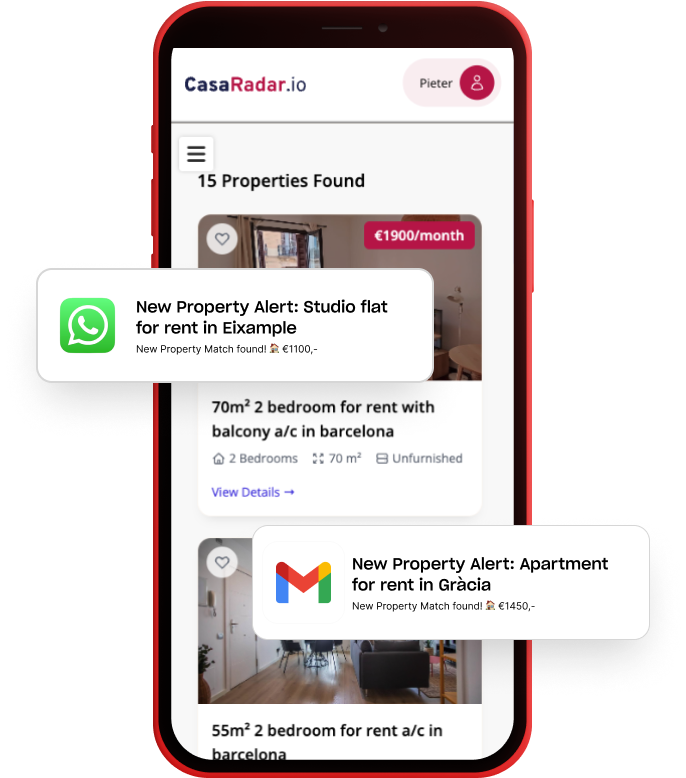
Where Rental House Listings Come to You
We track major and small real estate listing websites in Barcelona — so you don’t have to. Set your housing search criteria, and we’ll send you instant alerts the moment a new rental listing goes live that's fits your requirements.