

How to Get an Apartment in Barcelona as an Expat: The No-Nonsense Guide
Renting as an expat in Barcelona is achievable but requires strategy and timing. The biggest obstacles are no Spanish credit history, lack of local payslips, and language barriers. Start searching 4–6 weeks before your move; budget €3,000–5,000 for first month rent, deposit, and agency fees combined. Get temporary housing sorted first, then apply for NIE and open a Spanish bank account. Use a relocation agent (€300–600, worth it for first-timers) or navigate DIY with proper documents. Choose expat-friendly neighborhoods: Eixample (safe, central), Gràcia (community), Poblenou (creative), or Sant Antoni (trending). After signing, register your address for empadronamiento—it takes 15 minutes but unlocks healthcare, banking, and official residency.
Why Renting in Barcelona as an Expat Is Harder Than It Looks
Barcelona's rental market is competitive. Locals have Spanish credit history, payslips from Spanish employers, and landlord references. You have... a passport. Here's what makes it tough:
No Spanish credit history: You've never rented in Spain before. Landlords have no track record to check.
No Spanish employer payslips: Your boss is in London, Berlin, or Toronto. Barcelona landlords don't recognize "I work for Google in California"—they want proof from a Spanish employer.
Language barrier: Many landlords are older or old-school. English conversations happen, but official documents are Spanish. One contract clause you miss could hurt you later.
Tourist visa limitations: If you're on a tourist visa (90 days), landlords wonder: "Will they actually stay, or move out in 3 weeks?"
Relocation agent fatigue: You're new to the city. Do you trust the sketchy guy offering an apartment at 30% below market price on WhatsApp?
The scam factor: Barcelona's rental market has many scams targeting expats. More on this later.
But here's the good news: You can overcome every single one of these obstacles with preparation. This guide shows you how.
The Expat Apartment Hunt Timeline: Start 6 Weeks Before Your Move
Week 1–2: Preparation (Before You Arrive)
While still in your home country:
- Arrange temporary housing first. Don't arrive homeless.
- AirBnB for 2–4 weeks (€40–80/night, adds up but essential)
- Serviced apartment (€50–100/night, includes utilities)
- Friend's couch (free, but limits apartment hunting time)
- Hostel with private room (€25–40/night, social safety net)
- Book it now—cheaper rates in advance
- Get documents ready in PDF format:
- Passport (first and last pages)
- Visa or residence permit (if applicable)
- Last 3 months of payslips from home country job
- Employment contract or offer letter for Barcelona job (if you have one)
- Bank statements showing €3,000–5,000 available
- University enrollment letter (if student)
- Apply for your visa (if applicable):
- Digital Nomad Visa: 2–4 weeks lead time (do this before moving)
- Expat work visa: Depends on your employer, but often takes 4–6 weeks
- Student visa: Done with your university's help
- Without a visa: Tourist visa (90 days) is automatic for most non-EU citizens
- Research neighborhoods: Pick your top 3 based on the next section. Narrow your hunt geographically.
- Join Facebook groups: "Housing Barcelona," "Apartments in Barcelona," "Barcelona Expats." Start passively scrolling—get a sense of prices, scams, legitimate options.
Week 3–4: Active Search (Start Now, From Anywhere)
While still in your home country, start applying:
Set up alerts on main platforms:
- Idealista.com (Spain's biggest rental platform)
- Fotocasa.es (secondary to Idealista)
- HousingAnywhere.com (more flexible terms)
- Flatio.com (if you want furnished/shorter leases)
Schedule video viewings: Most landlords will do WhatsApp video tours. Ask for:
- Multiple angles of rooms
- Close-up of internet router (ask what provider/speed)
- Storage, kitchen quality, natural light
- Building entrance/common areas
- Street view from window
Research specific buildings/streets via Google Street View. Is the neighborhood where you think it is? Does the street look safe?
Start conversations with landlords: Use Google Translate if needed. Introduce yourself:
"Hello, I'm an expat relocating to Barcelona on [date] for work at [company]. I'm very interested in your apartment. I can move in on [date] and will provide all necessary documents. When would suit you for a viewing?"
Professional + timeline = landlords take you seriously.
Get a ballpark budget for your neighborhood:
- Eixample: €900–1,200/month (1-bed)
- Gràcia: €750–950/month
- Poblenou: €800–1,000/month
- Sant Antoni: €800–1,050/month
- Sarrià (quieter): €700–900/month
- Montjuïc (hilly): €750–950/month
Week 5: Decision & Deposit
Once you find THE apartment:
Negotiate the move-in date: Most landlords are flexible if you give 4+ weeks notice.
Agree on terms:
- Monthly rent
- What's included (utilities? heating? internet provider?)
- Deposit amount (usually 1–2 months rent)
- Agency fees (if using an agent, usually 1 month rent split 50/50)
- Contract duration (push for 1 year minimum—easier to extend than negotiate later)
Send signed intent: If required, send an email confirming you'll rent the apartment, subject to a formal lease signing.
Arrange payment method:
- Some landlords want a bank transfer before signing (risky—use escrow if available)
- Others collect on signing day in person
- Ask: "What's your preferred payment method?"
Week 6: Arrival & Signing
When you land in Barcelona:
- Move into temporary housing immediately. Don't stress about finding an apartment while jet-lagged.
- Book your NIE appointment online (if you need one—see next section):
- Go to cita.seg.gob.es
- Select "Solicitud de asignación de NIE"
- Pick your regional office (Barcelona = Barcelona Central Police)
- You'll get an appointment 2–4 weeks later
- Schedule a final in-person viewing (do NOT sign without seeing it in person).
- Open a Spanish bank account (optional but helpful):
- Find a bank branch (Banco Sabadell, CaixaBank, Bankia all have English support)
- Bring passport, proof of income, temporary address
- Takes 30 minutes; you'll get a card in 1–2 weeks
- Sign the lease:
- Invite a translator if you're unsure about Spanish
- Read it carefully (see "Common Contract Traps" below)
- Get a copy for yourself
- Pay the first month + deposit
- Get your keys and move in.
- Start NIE/empadronamiento process (see section below).
Overcoming the Obstacles: Solutions to Every Expat Problem
Obstacle #1: No Spanish Credit History
What landlords worry: You'll skip town without paying rent.
Solution 1: Provide a previous landlord reference
- Call your old landlord and ask for a written letter (carta de recomendación)
- Have them state: dates you lived there, you paid rent on time, you left the property clean
- This is gold—one landlord reference solves 80% of trust issues
Solution 2: Bank statements + savings proof
- Show 3 months of bank statements
- Highlight account balance (€5,000–10,000 = reassuring)
- Landlords see savings = stability
Solution 3: Pay a larger deposit
- Instead of 1 month deposit, offer 2 months
- Signal: "I'm serious about this."
- You'll get it back when you move out (if you don't damage anything)
Solution 4: Offer first month's rent + deposit upfront
- Pay immediately upon signing
- Removes landlord's risk
- Moves you to the front of the line if multiple applicants
Obstacle #2: No Spanish Employer Payslips
What landlords worry: Your Barcelona job doesn't exist yet, or you don't have stable income.
Solution 1: Bring an employment contract or offer letter
- From your Barcelona employer (even if start date is 2 weeks away)
- Shows: "I have a job, I have a salary, I can pay rent"
- English is fine; landlords recognize employment contracts
Solution 2: Bring payslips from your home country job
- If you still work remotely for a non-Spanish employer
- Include a cover letter: "I continue to work remotely for [Company] earning €[X] monthly. This income is permanent."
- Landlords may accept remote work (increasingly common post-COVID)
Solution 3: Letter from your HR department
- Have your employer's HR send a formal letter stating:
- Your employment status (permanent/contract)
- Your salary
- Your job title
- Letter is signed on company letterhead
- Takes 5 minutes for HR; worth gold to a landlord
Solution 4: Self-employed / Freelancer?
- Show last 12 months of tax returns (declaración de la renta)
- Show bank statements with consistent deposits
- Get your accountant to write a letter confirming income
- Offer a guarantor (parent with stable income)
Solution 5: Be a student or unemployed?
- Use a guarantor (parent, relative, spouse)
- Guarantor provides: proof of income, signed guarantee letter
- Guarantor's income is evaluated instead of yours
- This is common in Barcelona—landlords understand
Obstacle #3: Language Barrier
What landlords worry: Miscommunication = contract disputes.
Solution 1: Use Google Translate
- Copy-paste Spanish into Google Translate
- Check back to English to verify meaning
- Works 85% of the time for real estate Spanish
- Landlords expect this—don't stress about it
Solution 2: Hire a translator for contract review (€30–50, 1 hour)
- Fiverr.com or local translator services
- Review the contract before signing
- Ensures no hidden clauses surprise you later
- Best investment you'll make
Solution 3: Bring a Spanish-speaking friend to the signing
- Free translation + witness for the signing
- Landlords appreciate a witness (even informal)
Solution 4: Ask for an English version (sometimes exists)
- Some international properties have bilingual contracts
- Worth asking: "Do you have an English version of the lease?"
- 20% of landlords will say yes
Obstacle #4: Tourist Visa Limitations (Non-EU Citizens)
What landlords worry: You'll leave Spain after 90 days.
Solution 1: Get a long-term visa before moving
- Digital Nomad Visa (self-employed: €90 fee, renewable yearly)
- Work visa (if your employer sponsors you)
- Student visa (if enrolled at a Barcelona university)
- Any long-term visa removes this doubt
Solution 2: If you only have a tourist visa, be honest
- Tell the landlord: "I'm on a tourist visa, but I'm applying for [type] visa soon"
- Show proof of visa application (appointment email, etc.)
- This transparency builds trust
Solution 3: Offer a guarantor with clear legal status
- Non-EU guarantor = less reassuring
- EU guarantor = more reassuring
- Guarantor's legal status matters to landlords
Solution 4: Sign a shorter lease (3–6 months)
- Some landlords accept tourists for shorter terms
- "Let's try 3 months; if it works, we'll extend"
- Less risky for both parties
Neighborhoods: Where Expats Actually Live (And Why)
Eixample: The Safe, Central, Professional Choice
Rent: €900–1,200/month (1-bedroom)Vibe: Modern, grid-planned, walkable, upscale, safe, a bit sterile
Why expats love it:
- Close to everything (15 minutes to Gothic Quarter, Sagrada Família, Park Güell)
- Excellent metro/bus (metro lines 2, 3, 5 intersect here)
- Safe streets, good police presence
- Supermarkets, pharmacies, restaurants every 50 meters
- Professional atmosphere (good if you're working)
Why you might not: Less character than hipper neighborhoods; it's expensive; can feel corporate.
Best streets: Passeig de Sant Joan, Carrer de Còrsega, Avinguda Diagonal, Carrer de Balmes
Schools nearby: Good international schools (St. George's, British School of Barcelona)
Gràcia: The Community & Culture Hub
Rent: €750–950/month (1-bedroom)Vibe: Bohemian, artsy, village-like, local, younger crowd, great bars/restaurants
Why expats love it:
- Tight-knit expat + local community
- Plaça del Sol and Plaça de la Virreina = social hubs (everyone knows everyone)
- Great independent restaurants, bookstores, vintage shops
- Close to Park Güell and Sagrada Família
- Slower pace; feels like you're "in Barcelona," not just passing through
Why you might not: Less central than Eixample; noisier (nightlife + people); slightly less safe at night in some corners; apartments are smaller.
Best streets: Plaça del Sol, Plaça de la Virreina, Carrer de Còrsega
Schools nearby: Fewer international schools; more bilingual/Spanish schools.
Poblenou: The Creative's Playground
Rent: €800–1,000/month (1-bedroom)Vibe: Trendy, creative, street art, design studios, young professionals, some tourists, gentrifying fast
Why expats love it:
- Digital nomad hub (lots of coworking, cafés, other expats)
- Excellent internet (mostly fiber)
- Walkable to beaches and Port Vell
- Design shops, indie cafés, galleries
- Feels like "Barcelona's Brooklyn"
Why you might not: Increasingly touristy; some areas still rough; parking is nightmare; very expat-heavy (less "authentic Barcelona").
Best streets: Carrer de Ramón y Cajal, Carrer de la Industria, Ronda del Raval
Schools nearby: Limited international school options.
Sant Antoni: The Rising Star
Rent: €800–1,050/month (1-bedroom)Vibe: Gentrifying fast, food scene, weekend market, young professionals, trendy-but-local feel
Why expats love it:
- Excellent food scene (pintxo bars, restaurants, cafés)
- Sant Antoni Market on weekends (street food, shopping, atmosphere)
- Cheaper than Eixample, hipper than you'd expect
- Near Mercat de Sant Antoni (historic, beautiful)
- Growing expat community without being obvious about it
Why you might not: Still gentrifying (changing vibe quickly); less established than other neighborhoods; fewer metro connections; some sketchy blocks.
Best streets: Carrer de Blai, Carrer del Parlament, Carrer de Còrsega
Schools nearby: Moderate options; mostly bilingual/Spanish.
Sarrià: If You Want Peace & Quiet
Rent: €700–900/month (1-bedroom)Vibe: Quiet, village-like, older residents, green spaces, slow pace
Why choose it: Mountains nearby, beautiful parks, excellent schools, very safe, relaxed. Older expats, families with kids often choose this.
Why avoid it: 30+ minute metro ride to central Barcelona; feels like suburbs; less nightlife; isolated if you're social.
Cost Breakdown: Budget the Right Amount for Your Move
One-time costs (upfront):
- First month rent: €800–1,000 (example)
- Deposit (fianza): €800–1,000 (usually same as 1 month rent; you get it back)
- Agency fee (if using agent): €800–1,000 (50% paid by tenant, 50% by landlord—negotiate this)
- Total upfront: €2,400–3,000
Plus moving costs:
- Flights: varies
- Temporary housing (2–4 weeks): €800–2,400
- International moving (if bringing furniture): €2,000–5,000
- Or buy secondhand furniture in Barcelona: €500–1,500 (IKEA, Vinted, Facebook Marketplace)
Monthly recurring:
- Rent: €800–1,000
- Utilities (water, electricity, gas): €60–100
- Internet: €30–50
- Cleaning/maintenance: €50–100
- Total: €940–1,250/month
Real example (Gràcia, 1-bedroom, family moving):
- Flights (2 people): €600
- Temporary housing (3 weeks): €1,800
- Furniture/kitchenware: €800
- First month rent + deposit + agency fee: €2,700
- First month utilities + internet: €80
- Total: €5,980 for the move
- Ongoing: €1,050/month
Using a Relocation Agent vs DIY: The Tradeoff
DIY Apartment Hunting (Save €300–600)
Process:
- Search on Idealista/Fotocasa yourself
- Contact landlords directly via WhatsApp/email
- Schedule viewings
- Negotiate terms
- Sign contract yourself
Pros:
- Save agency fees (€300–600)
- Learn the city better
- Direct relationship with landlord
- Full control
Cons:
- Time-consuming (40+ hours of research/viewings)
- Scam risk (DIY hunters fall for scams more often)
- Contract review requires translator (another cost)
- Stress if you don't speak Spanish
- Apartment hunting while jet-lagged is brutal
Best for: People who are patient, speak some Spanish, arrive 4+ weeks before needing to move.
Relocation Agent (Cost €300–600, But Worth It)
What they do:
- Search apartments matching your criteria
- Arrange viewings (you don't attend—they provide virtual tours + photos)
- Negotiate with landlords
- Review contracts (in English or with translation)
- Handle paperwork (signing, deposits, keys)
- Help with NIE, empadronamiento afterward
Pros:
- Save enormous time (20+ hours)
- Avoid scams (they know landlords)
- Contract review included
- Translator included
- Less stress during move
- They negotiate better rates (sometimes)
Cons:
- Cost €300–600
- Less personal control
- Landlord relationship is distant
- Some agents are mediocre
Companies:
- Barcelona Apartments (relocation specialist, €400–600)
- Relocate Abroad (expat-focused, €350–500)
- Habitat Barcelona (mid-range, €300–400)
- Local real estate agents (mixed quality, €300–500)
When to use a relocation agent:
- You're moving with family
- You don't speak Spanish
- You're arriving and need apartment ASAP
- You're moving from outside Europe (distance = barrier)
- You have limited time to house hunt before arrival
When to DIY:
- You speak intermediate Spanish
- You arrive 6+ weeks before needing housing
- You're comfortable with some risk
- You want to learn the city organically
- Budget is tight
Our recommendation: First-time expats = use a relocation agent. You'll spend €300–600 and avoid 20+ hours of stress. Worth it.
The Viewing-to-Signing Process: What to Expect
Before the Viewing
- Ask the landlord these questions via WhatsApp/email:
- Move-in date (flexible?)
- Contract length (1 year minimum?)
- Utilities included or separate? (Specify: water, gas, electricity, garbage)
- Internet provider + speed?
- Deposit amount?
- Agency fee (if applicable)?
- Pet-friendly?
- Furniture (included, removable, or unfurnished)?
- Confirm the viewing time and location. Some landlords are flaky.
During the Viewing
Spend 30–45 minutes. Check:
- Light & natural ventilation: Open windows. Can you breathe? Is there mold smell?
- Plumbing & water pressure: Turn on all taps. Is water hot? Pressure good?
- Electrical outlets: Do they work? Enough outlets in bedrooms?
- Internet router location: Is Wi-Fi coverage good? Ask what provider/speed.
- Noise: When are the noisy hours? (Neighbors, street, nightlife)
- Building security: Lock on entrance? Intercom?
- Storage/closets: Enough space?
- Kitchen appliances: Do they work? Refrigerator clean?
- Flooring: Hardwood good, carpet mediocre (hard to clean). What about scratches/damage?
- Walls: Any cracks, water stains, mold? Take photos.
- Hot water: Works? Takes long to heat up?
- Heating/AC: Does it exist? Works?
Take photos/video of EVERYTHING (landlords expect this). Protects you later if they claim you damaged something you didn't.
Ask: "How long have you owned this apartment? Have any previous tenants complained about [X]?"
After the Viewing (Before Committing)
- Sleep on it. Don't sign same-day. If landlord pushes ("Others are interested"), walk away—it's often a scam tactic.
- Visit the neighborhood at different times:
- Daytime: Is it lively, clean, safe?
- Evening: How's the nightlife noise?
- Weekend morning: Street vibe?
- Check commute: Take public transit to your workplace. Takes 20 minutes? Perfect. Takes 45? Maybe not.
- Research the building online:
- Google Maps: Read Google reviews, look for complaints about noise/landlords
- Idealista history: Has this apartment been listed for 6+ months? (Red flag—something's wrong)
- Facebook groups: Ask "Has anyone rented at [address]? Experiences?"
- Final decision: If it feels right, move forward.
The Contract (Lease Agreement)
Get a translator to review it. Here's what to check:
Essential terms:
- Tenant name, landlord name, property address
- Monthly rent amount
- Payment method + date (usually 1st of month)
- Deposit amount
- Lease duration (start date, end date)
- Notice period (usually 30 days from either party)
Critical clauses:
- What's included in rent? (Utilities? Internet? Heating?)
- Who pays what? (Water? Electricity? Gas? Garbage? Building maintenance?)
- Pet policy
- Guest policy (can you have people over?)
- Smoking (allowed?)
- Noise restrictions (quiet hours?)
- Maintenance responsibility (landlord vs tenant)
- Damage policy (normal wear-and-tear covered? What if you break something?)
- Rent increase clause (max 2% yearly is standard)
Red flags in contracts:
- Vague wording about deposits ("You forfeit deposit if you leave before 12 months")
- Tenant pays for all repairs (not normal—landlord should handle major stuff)
- No mention of deposit protection (should go to INCASOLL, a government registry)
- Excessive restrictions (no guests after 10 PM, no cooking, weird rules)
- Demands for additional payments beyond rent (building fees, "extras")
What to negotiate:
- Lease length: Push for 1 year minimum (gives you stability, cheaper than renewing annually)
- Deposit: Try to negotiate 1 month instead of 2 (especially if paying first month upfront)
- Agency fee: 50/50 split is normal (you pay half, landlord pays half)—verify this is stated in contract
Before signing:
- Get it in Spanish AND English (if possible)
- Have translator review both
- Ensure deposit goes to official registry (INCASOLL)—ask landlord
- Get a copy for yourself
Sign and pay:
- Usually: First month rent + deposit paid on signing day (via bank transfer or in cash)
- Get a receipt for everything
- Take a photo of the signed contract both parties agree to
After You Sign: The NIE, Empadronamiento, and Official Residency
Getting a NIE (Número de Identidad de Extranjero)
What it is: Your foreigner ID number. It's Spain's version of a Social Security number for non-citizens.
Do you need it? Eventually yes (for taxes, employment, healthcare). Immediately? Not for renting, but helpful.
Timeline: 2–4 weeks to get an appointment; 20 minutes to get it done.
How to apply:
- Go to cita.seg.gob.es (Spanish site)
- Select region: Barcelona (Barcelona Central Police)
- Click "Solicitud de asignación de NIE"
- Pick an appointment date (usually 2–4 weeks out)
What to bring:
- Passport (original + copy)
- Proof of legal residency (lease agreement works)
- Completed form EX-15 (fill in at the office)
- €10.50 fee
What you'll get: A pink NIE card—print it, laminate it, carry it with you.
Getting Empadronamiento (Municipal Registration)
What it is: Your official residency registration. Proves you live at your Barcelona address.
Why it matters:
- Unlocks access to Spanish healthcare (SNS)
- Required for some banking
- Proves legal residency
- Opens doors to social services if needed
Timeline: Can do this immediately after getting keys. Takes 15 minutes in person.
How to register:
- Go to your local Junta de Distrito office (district town hall)
- Bring: Passport, lease agreement, proof of address (lease is enough)
- Fill out form (padron form—they have templates)
- Pay small fee (~€10) or nothing (varies by district)
- Get a certificate on the spot
Find your local office: Search "Junta de Distrito Barcelona" + your neighborhood name.
Pro tip: Some Juntas are very expat-friendly; others are slow. Call ahead: "Hola, what do I need for empadronamiento?" (or use translator). Some will tell you to come at specific times (less busy hours).
Healthcare After Moving
With empadronamiento: You can register with Spanish SNS (National Health Service)—free healthcare access.
Without it: Use private insurance (€40–80/month) or pay out-of-pocket (Barcelona clinics are cheap by US standards: €100–150 for doctor visit).
Common Contract Traps for Foreigners (And How to Avoid Them)
Trap #1: Deposit Gets Absorbed Into "Damages"
The scam: You move out, landlord claims: "Walls are marked, carpet has stain, door handle is broken." Deposit = forfeited.
Reality check: Normal wear-and-tear is landlord's responsibility, not yours.
How to protect:
- Take photos of EVERYTHING on move-in day
- Email landlord: "Here are move-in photos. We agree this is the condition we're receiving."
- Get landlord's written acknowledgment
- On move-out, take photos again in same spots
- Keep all photos + emails
Trap #2: Utilities Aren't Specified, Landlord Charges You Twice
The scam: Contract says "rent includes utilities." Move-out, landlord sends bill: "You owe €400 in unpaid gas." Turns out previous tenant didn't pay, and landlord is billing you.
How to protect:
- Specify in contract: "Rent of €800 includes water, electricity, gas, garbage. Tenant is not responsible for utilities beyond this."
- Get landlord to sign this clause
- Take meter readings on move-in day (electricity, water, gas)
- Verify bill only covers your tenancy period
Trap #3: Early Lease Break = Forfeited Deposit
The scam: Contract says: "If you leave before 12 months, you forfeit deposit." You get a job transfer after 8 months. Oops.
How to protect:
- Negotiate exit clause: "Either party can terminate with 30-day notice and 1-month penalty" (not full deposit)
- Or get commitment from landlord you can break early with 2-month notice
- Put this in writing
Trap #4: Rent Can Increase Anytime
The scam: Contract is vague about rent increases. After 6 months, landlord says: "Rent is now €950" (up from €850).
How to protect:
- Spanish law caps rent increases at ~2% annually (but this is often ignored by lazy landlords)
- Put this in contract explicitly: "Annual rent increase capped at 2% or CPI [index], whichever is lower"
- Get this in writing
Trap #5: Landlord Uses Deposit for Own Repairs
The scam: You move out, deposit is kept to fix things. But some of it goes to landlord's personal projects, not your damage.
How to protect:
- Deposit MUST go into INCASOLL (government account), not landlord's personal bank
- Ask: "Will my deposit be held in an escrow account (cuenta de depósito)?"
- Get written confirmation
- On move-out, document condition and email landlord before you leave
Scams: What to Avoid
Red Flag #1: Suspiciously Low Prices
Reality: 1-bedroom in Gràcia costs €750–900. If someone offers €500, it's fake.
What to do: Walk away.
Red Flag #2: "Send Money Before Viewing"
Reality: No legitimate landlord does this.
What to do: Demand an in-person viewing. If they refuse, it's a scam.
Red Flag #3: Photos Are Stock Images or Blurry
Reality: Landlords with legitimate apartments send clear, recent photos.
What to do: Ask for video walkthrough. If they refuse, move on.
Red Flag #4: Payment Method is Western Union / Gift Cards / Cryptocurrency
Reality: Landlords accept bank transfers, cash (in person), or checks.
What to do: Only use legitimate payment methods.
Red Flag #5: Landlord Only Communicates via WhatsApp, Never Calls or Meets
Reality: Scammers hide; legitimate landlords talk.
What to do: Insist on a phone call or in-person meeting before signing anything.
Red Flag #6: Landlord Can't Provide ID or Proof of Ownership
Reality: Landlords can show a lease, property deed, or something proving they own/manage it.
What to do: Ask for proof of ownership before signing. If they refuse, walk.
Red Flag #7: Rush Pressure ("Someone Else Is Interested, Decide Now")
Reality: Good apartments take time. Scammers create artificial urgency.
What to do: Take 24–48 hours to decide. If landlord pressures, move on.
The First Month Checklist
When you get keys:
- [ ] Take photos/video of everything (whole apartment)
- [ ] Check all utilities work (water, electricity, gas, heating, AC)
- [ ] Test internet speed (should match what landlord promised)
- [ ] Take meter readings (electricity, water, gas)
- [ ] Introduce yourself to neighbors (they're helpful later)
- [ ] Find nearest Metro station, bus stop, supermarket, pharmacy, police station
- [ ] Register with your embassy (some countries require this)
- [ ] Apply for NIE (online via cita.seg.gob.es)
- [ ] Register for empadronamiento (at your local Junta de Distrito)
- [ ] Open Spanish bank account (if you haven't)
- [ ] Buy house insurance (optional but good idea, €5–10/month)

Ready to Find Your Rental Place in Barcelona?
Frequently Asked Questions About How To Get An Apartment In Barcelona As An Expat
Here are answers to some of the most common questions we receive.
How long does it take to find an apartment in Barcelona?
If you start 4–6 weeks before moving, typically 2–4 weeks. If you DIY and don't speak Spanish, maybe 4–6 weeks. If you use a relocation agent, 1–2 weeks start-to-finish. Starting later = more expensive (rush premium) and stressful.
What's the cheapest neighborhood for expats in Barcelona?
Sarrià (€700–900/month) and Sant Antoni (€800–950) are cheaper. Gràcia (€750–950) and Poblenou (€800–1,000) offer better value. Eixample is priciest (€900–1,200) but most central.
Do I really need a relocation agent, or can I find an apartment myself?
You can DIY if you speak intermediate Spanish and have 4+ weeks. First-timers benefit from an agent (€300–600 investment saves 20+ hours and reduces scam risk). Your call based on budget and comfort level.
What documents do I need to rent in Barcelona?
Passport, 3 months payslips (or employment contract), bank statements (€3,000+), and optionally a previous landlord reference. Non-EU citizens need a valid visa or residence permit.
Is it cheaper to rent furnished or unfurnished in Barcelona?
Unfurnished is cheaper (€100–200/month less) but requires longer commitment (1+ year lease) and upfront costs. Furnished is month-to-month flexible but pricier. For first 6–12 months, furnished often makes sense.
What if I can't afford the first month + deposit + agency fees upfront?
Some landlords allow payment plans (first month now, deposit in 2 weeks). Some platforms like HousingAnywhere split the cost. Or use a relocation agent—they sometimes have landlord relationships that allow flexibility.
Do I need an NIE to rent an apartment in Barcelona?
No. NIE is helpful later (for taxes, healthcare, work). Apply within first month of arriving. Passport + visa is sufficient for renting.
What does empadronamiento do for me?
It registers your address officially. Opens access to Spanish healthcare (SNS), helps with banking, and proves legal residency. Do it within 2 weeks of moving—takes 15 minutes at your local Junta de Distrito.
Can I negotiate rent in Barcelona?
Sometimes. Try: "Can you do €850 instead of €900 if I sign a 2-year lease?" Landlords are more likely to negotiate if you're a good tenant (good references, employed, no pets). Don't expect huge discounts—expect 5–10% in competitive markets.
What if I have a bad roommate or want to move after 6 months?
Check your contract's exit clause. Standard is 30-day notice + 1-month rent penalty. Some landlords allow free exits with 30 days notice. Negotiate this before signing if you're uncertain about staying.
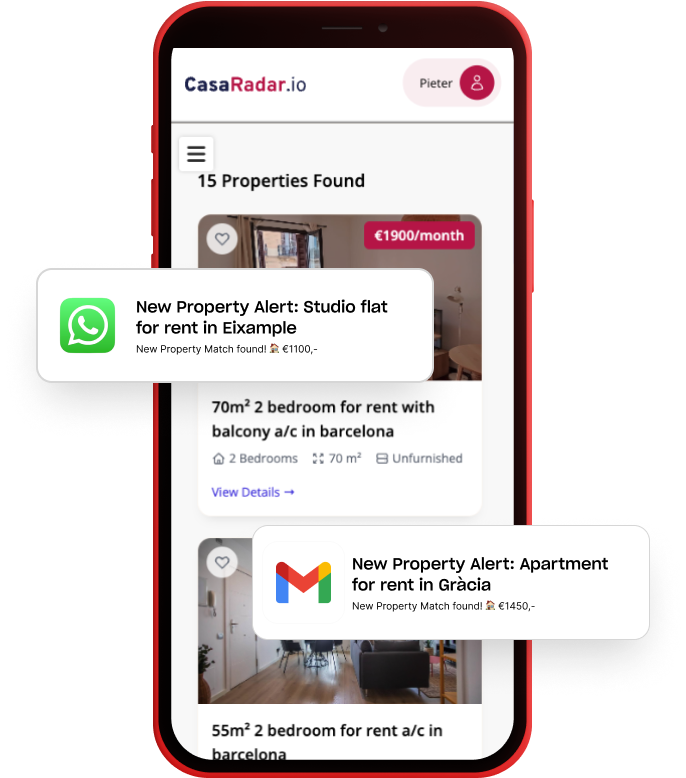
Where Rental House Listings Come to You
We track major and small real estate listing websites in Barcelona — so you don’t have to. Set your housing search criteria, and we’ll send you instant alerts the moment a new rental listing goes live that's fits your requirements.