

How to Get Accepted for an Apartment in Barcelona (Tips for Expats)
Renting an apartment in Barcelona as an expat can feel like trying to win a race you never trained for. Flats disappear within minutes, agents receive 50+ messages per listing, and requirements feel unclear. But with the right preparation, speed, and strategy, expats absolutely can get accepted — even without a NIE, local income, or prior Spanish rental history.
The secret isn't luck or connections. It's understanding what Barcelona agents actually look for, preparing the right documents, communicating clearly, and moving faster than the crowd. Thousands of expats successfully rent in Barcelona every year, and you can too.
This comprehensive guide walks you through every step of the process — from the documents you need, to the messages that get responses, to the psychology of why agents choose one tenant over another. By the end, you'll know exactly how to position yourself as the kind of tenant every landlord wants to work with.
Why Expats Often Get Rejected (And Why It's Not Personal)
The first thing to understand is this: expats don't get rejected because they're foreigners. They get rejected because they're not ready, or they're not first in line.
When a nice flat hits the market in Barcelona, it's not unusual for an agent to receive 50, 100, or even 150 inquiries within the first 2 hours. Most agents use a simple filter to manage this chaos: they look for the applicants who appear organized, responsive, and low-risk. If your application is incomplete, if you take hours to reply, or if your message is vague, they move on to someone else — not out of preference, but out of necessity.
Here's what agents are thinking when they scan your message:
- Can I understand this person's situation quickly?
- Do they have their documents ready, or will this take weeks?
- Are they serious, or just browsing?
- Will they be difficult to work with?
- Can they actually afford the rent?
When you fail to answer these questions clearly, you don't get rejected because you're an expat. You get rejected because you look like you'll create more work.
The good news? Most of these barriers are completely within your control.
What Barcelona Agents and Landlords Actually Look For
To get accepted, you need to understand the agent's priorities. They're not trying to be difficult. They're under time pressure, managing dozens of listings, and looking for the path of least resistance.
Proof you can pay rent reliably. This is #1. Agents want evidence that you earn enough to cover the rent comfortably. For locals, they usually ask for a work contract or recent payslips. For expats, they want to see the same thing, whether it comes from a foreign employer or a remote job. Some agents also appreciate bank statements showing that you have savings as backup.
Organized, complete documentation. If you hand over all your documents in one clean package instead of sending scattered photos and emails over days, you signal that you're serious and easy to work with. This single factor can bump you ahead of applicants with higher salaries but messier applications.
Fast, professional communication. Agents are juggling multiple listings and viewings. They appreciate tenants who reply within minutes, not hours. Your tone matters too — friendly but professional, clear but not demanding.
Willingness to sign quickly. Agents love applicants who can commit fast. In Barcelona's competitive market, the tenant who can sign a contract and pay the deposit within 48 hours often gets the flat over someone with a higher salary who wants time to think.
Low-risk profile. This doesn't mean you need to be wealthy. It means you appear stable. Steady employment (even remote), positive rental history if available, professional communication, and references all help. Remote workers and corporate employees are often seen as lower-risk than freelancers, simply because their income feels more predictable.
Understanding of Spanish rental norms. You don't need to be Spanish, but understanding how the rental market works shows that you're not going to be a difficult tenant. Knowing about the fianza (deposit), typical contract lengths, and standard utilities arrangements puts you ahead of someone asking naive questions.
Step 1: Prepare the Documents That Matter Most
Before you search for a single flat, gather your documentation. Having everything ready is the single biggest competitive advantage you can create. When an agent asks for documents, replying with a complete package within 10 minutes changes everything.
For EU Citizens
Start with the basics. You'll need:
- Passport or National ID (clear photocopy)
- Proof of income (3 recent payslips, work contract, or employment letter)
- Bank statements (optional but helpful — showing 2-3 months of activity)
- Employer letter (on company letterhead, confirming your position and salary)
If you're employed and earning a stable salary, this is often sufficient. Many EU citizens find that their home country's employment letter carries more weight than locals might expect.
For Non-EU Citizens
The process is slightly more involved, but still very achievable:
- Passport (valid for your entire intended stay)
- Work contract or remote job letter (clearly stating your salary and position)
- Visa-related documents (copy of your visa or authorization, if applicable)
- Bank statements (showing healthy finances for the past 2-3 months)
- Proof of employment from your home country (if applicable)
A common concern: "Do I need a NIE to rent?" The short answer is no. You can rent without a NIE, and most agents understand that getting one takes time. Simply mention in your application that you have a NIE appointment scheduled or that you're in the process of obtaining one. Many agents will accept this and help you complete the NIE process after you've signed the contract.
For Freelancers and Remote Workers
Agents sometimes view freelancers with more caution because income can feel less stable. Counter this by being extra thorough:
- Recent invoices (showing the last 2-3 months of client work)
- Client contracts (proving ongoing work relationships)
- Tax declarations (if available from your home country, showing your declared income)
- Bank statements (showing consistent monthly deposits)
- Employer or client letter (on official letterhead, confirming you have ongoing work and expected income)
The key for freelancers is demonstrating consistency. If you have 3-5 months of invoices showing regular income, you're actually in a strong position.
For Students
If you're studying in Barcelona:
- University enrollment letter (proof of current studies)
- Scholarship or funding letter (if applicable)
- Bank statements (showing you can cover rent if no income)
- Parent guarantor letter (signed document from a parent confirming they'll guarantee rent if needed)
Many Barcelona landlords are accustomed to renting to students, and they often accept a guarantor in your home country as an alternative to local income.
Step 2: Create a "Rental Application Package"
Here's a step that separates serious applicants from everyone else: create a rental application package.
This isn't something agents ask for. But when you have one ready, it puts you ahead of 90% of applicants.
A rental application package is simply a clean, organized PDF or folder containing:
- A short introduction (3-5 sentences about yourself)
- Your passport (photocopy)
- Proof of income (contract, payslips, or employment letter)
- Bank statement (showing you have money for deposit and first month)
The introduction is the secret weapon. Write something like this:
"Hello, my name is [Your Name]. I'm a [your job title] working for [company], earning approximately €[monthly salary]. I'm relocating to Barcelona on [date] and am looking for a long-term apartment. I'm organized, reliable, and ready to move quickly. All my documents are included below, and I'm prepared to visit, sign, and pay the deposit within 48 hours if the flat suits my needs."
This takes 30 seconds to write and changes everything. When you reply to an agent's request for documents, instead of sending scattered photos and emails, you send one professional package. The agent can understand your entire situation in 10 seconds. They see you're not going to be difficult. They see you're ready. They see you're serious.
This is psychology, not trickery. Agents are drowning in applications. Being the one person who makes their job easier is a massive advantage.
Format it simply: Use a PDF, name it clearly ("Application_YourName.pdf"), and keep the design clean. You don't need fancy graphics — just readability.
Step 3: Write Messages That Get Responses
Most messages agents receive are ignored instantly because they're vague, short, or both: "Is this available?" "How much?" "I'm interested."
Your message needs to do three things in under 100 words:
- Prove you're real (use your actual name, not a nickname)
- Signal seriousness (mention your documents are ready)
- Show readiness (suggest a specific time to view)
Here's a template that works across platforms:
English Template:
"Hello [Agent Name], my name is [Your Name]. I'm relocating to Barcelona for work and I'm very interested in your [apartment type, e.g., '2-bed flat in Gracia']. I have all my documentation ready (passport, income proof, and bank statements), and I'm available to visit tomorrow or the day after. I'm prepared to move quickly if the flat is suitable. Please let me know the next available viewing time. Thank you!"
Spanish Template:
"Hola [Agent Name], me llamo [Your Name]. Me estoy mudando a Barcelona por trabajo y estoy muy interesado en tu [apartment details]. Tengo toda mi documentación lista (pasaporte, prueba de ingresos, y extractos bancarios), y estoy disponible para visitar mañana o pasado mañana. Estoy preparado para actuar rápidamente si el piso es adecuado. ¿Cuál es el próximo horario de visita disponible? ¡Gracias!"
Why this works:
- You're personable but professional
- You remove uncertainty (agents know you have documents)
- You show speed (can visit tomorrow)
- You're respectful of their time
- You're not demanding, just clear
Tips to Increase Your Reply Rate
- Send immediately. The moment a listing appears, send your message. Being first in the inbox matters.
- Be specific about timing. Don't say "I'm available sometime." Say "I can visit tomorrow at 10 AM or 3 PM."
- Include your phone number. Agents like to call when they want to confirm a viewing. Make it easy.
- Use the agent's name if available. "Hello María" feels warmer than "Hello."
- Mention you're local or will be soon. If you can visit today or tomorrow, say so. It proves you're not calling from another country.
Step 4: Respond Faster Than Everyone Else
Here's the harsh reality of Barcelona's rental market: speed is the primary factor in getting accepted.
When an apartment is listed, the agent's inbox is flooded within minutes. Many agents stop accepting viewing requests after 30-60 minutes because they already have 10+ serious inquiries. By the time you finish work, grab coffee, and refresh Fotocasa, the viewings are already booked.
This is why most expats feel like they're always too late.
Manual browsing is a losing strategy. By the time you see a listing, dozens of people have already contacted the agent. You're competing against people who saw it 5 minutes after it was posted.
This is where CasaRadar changes the game. Instead of checking multiple websites manually, you receive instant alerts the moment new listings match your criteria. You're not just faster — you're first. You become the first message in the agent's inbox, and that single advantage often determines whether you get a viewing.
In competitive months like August and September, when quality flats are scarce and hundreds of expats are searching simultaneously, being first isn't just helpful — it's often the difference between getting accepted and getting rejected.
Think of it this way: if you can be in the top 5 applicants for every viewing you pursue, your acceptance rate skyrockets. CasaRadar instant alerts ensure you're not just in the top 5 — you're often #1 or #2.
You can learn more about how to set up alerts and stay ahead of the competition at our guide on barcelona-house-and-room-rental-alerts-get-instant-notifications-from-all-major-and-small-housing-platforms.
Step 5: Make a Strong Impression at the Viewing
By the time you arrive at a viewing, you've already done most of the work. Now it's time to reinforce the positive impression you made in your message and application.
Arrive early. Show up 5 minutes before your scheduled time. This signals respect and reliability — exactly what landlords notice.
Be polite and genuinely interested. Ask practical questions about the space, not confrontational ones. Good questions include:
- "Are utilities included, or do I pay separately?"
- "What type of contract do you offer — 1 year, 2 years?"
- "When can I move in?"
- "What's the move-out process?"
These questions show that you understand the process and are thinking long-term.
Don't negotiate during the viewing. This is crucial. Agents can sense when someone is trying to lowball them, and it creates tension immediately. Secure the flat first, negotiate later (if at all).
Ask about the neighborhood too. This shows genuine interest beyond just getting a place. "Is this a quiet area? Are there good cafes nearby? Is it easy to access public transport?" These questions make you feel like someone who's excited to live there, not just desperate for any flat.
Mention that you're ready to move fast. Before you leave, say something like: "I'm very interested in this place. If you confirm I'm approved, I can sign the contract and arrange payment within 48 hours." Agents love hearing this.
Check the actual condition carefully. During the viewing, pay attention to:
- Damp or humidity (common in Barcelona's older buildings)
- Noise from the street
- Plumbing and water pressure
- Natural light
- Internet connectivity (Barcelona's older buildings sometimes have poor signal)
- Heating situation (many flats have limited heating options)
These details matter for your long-term happiness, and agents respect tenants who think practically.
Step 6: Prove Financial Stability (Even Without a Spanish Contract)
One of the biggest myths expats believe is that you need a Spanish employment contract to rent in Barcelona. This is completely false, and it costs many expats the apartments they want.
Landlords care about one thing: can you pay the rent reliably? It doesn't matter if the money comes from a foreign employer, a remote job, freelance work, or savings.
What works for financial proof:
- Remote job contracts (showing salary, duration, and company details)
- Foreign employer letters on official letterhead (confirming your position and salary)
- Recent payslips from your home country employer
- Freelance invoices showing 2-3 months of consistent work
- Bank statements showing healthy income and savings
- A partner's income (if you're renting together)
- A guarantor from your home country (a parent or relative willing to guarantee rent)
The key is clarity and documentation. When you present foreign income, explain it clearly. Include a letter from your employer or client confirming the work is ongoing. Show bank statements proving the income actually arrives each month.
Many landlords actually prefer remote workers and corporate employees because their income feels more predictable than a local freelancer's. You have an advantage here — use it.
If you're concerned your foreign income won't be believed, provide extra documentation. Show 3-4 months of bank statements. Include an employment contract clearly stating your salary. Ask your employer for a letter confirming you're a permanent employee. Remove every doubt from the landlord's mind.
For more details on rent prices and what you can expect to pay, check out our guide on how-much-cost-rent-barcelona.
Step 7: Apply Immediately — Don't Wait Until Tomorrow
This is the step that trips up most expats.
If you like the apartment, apply the same day. Not tomorrow. Not after you think about it. Today.
Barcelona's rental market moves at lightning speed. The flat you viewed this afternoon might be rented to someone else by midnight. Many agents make decisions within 24 hours, and the tenants who apply first are always in a stronger position.
Here's what immediate application looks like:
- After the viewing, before you even leave the neighborhood, send a follow-up message to the agent: "Thank you for showing me the flat. I'm very interested and would like to proceed with my application."
- Send your complete documentation package that same day. Don't wait until tomorrow.
- Confirm your move-in date and any other details the agent asked about.
- Be prepared to discuss next steps. The agent might ask for references, additional information, or a contract signature. Have everything ready.
The standard Barcelona rental process looks like this:
- Agent confirms your interest and approves your application (1-2 days)
- You sign the contract and arrange payment (1-2 days)
- You pay the first month's rent + deposit (fianza) + any agency fee
- You receive keys and move in
From application to move-in typically takes 5-10 days if you move quickly. Waiting overnight can easily cost you the flat.
For more information about the fianza (security deposit) and how it works, see our guide on what-is-fianza-barcelona.
Step 8: Negotiate Carefully (Or Don't)
Barcelona is a landlord's market. In most months and neighborhoods, there's more demand than supply, which means landlords hold the power in negotiations.
When to negotiate:
- The flat has been online for 3+ weeks
- It's off-season (November to January)
- The property is in a less desirable area
- You're signing a 2-3 year contract
When NOT to negotiate:
- The flat is in high demand
- It's summer or September (peak season)
- You're the first applicant
- The landlord seems strict about price
If you do negotiate, keep it extremely light and reasonable. Asking for €50-100 off monthly rent is acceptable. Asking to cut the deposit in half will probably get your application rejected.
Remember: securing the flat is more important than saving €20 a month. You can always upgrade next year.
Common Mistakes That Lead to Rejection
Most expats don't get rejected because of something fundamental about who they are. They get rejected because they make one of these avoidable mistakes:
Sending unclear or incomplete messages. A 2-line message with "Is this available?" won't get a response when 100 other people sent detailed, professional inquiries.
Taking too long to reply. If the agent asks a question and you reply 6 hours later, they've already approved someone else.
Not having documents ready. If you tell the agent you'll send documents "tomorrow" or "next week," they move on. Instant is better.
Negotiating too early. Trying to lower the price before you're even approved is a red flag. It makes you look difficult.
Searching on only one platform. Idealista and Fotocasa are the biggest sites, but they're not the only ones. Many quality flats are listed on Habitaclia, Pisos.com, or even Facebook groups. Searching multiple platforms means more options.
Waiting for the perfect apartment. There's no such thing. If you see a decent flat in a decent area at a decent price in this market, you should apply. You can always upgrade later. Waiting for perfection while searching is a losing strategy.
Failing to emphasize your strengths. If you have savings, mention it. If you can pay the first month plus deposit immediately, say so. If you have references from previous landlords, provide them.
Final Thoughts
Getting accepted for an apartment in Barcelona as an expat isn't about luck, connections, or local knowledge. It's about preparation, clarity, and speed.
Once you understand how agents think, what they're filtering for, and how quickly the market moves, everything becomes simpler. The barriers that seem impossible at first — NIE requirements, foreign income, lack of Spanish rental history — are revealed as minor obstacles that thousands of expats overcome every year.
You have advantages too. As an expat, you might have savings, stable remote income, or corporate backing that many local applicants lack. Your main job is to present these advantages clearly and move faster than everyone else.
With the right approach — complete documents, professional communication, instant alerts, and decisive action — you'll find and secure a great Barcelona apartment much faster than you expect. And then the real adventure begins.
Welcome to Barcelona.

Ready to Find Your Rental Place in Barcelona?
Frequently Asked Questions About Getting Accepted for a Apartment in Barcelona
Here are answers to some of the most common questions we receive.
Can I rent an apartment in Barcelona without a NIE?
Yes. You can rent without a NIE, and many expats do so successfully. The NIE (Número de Identidad de Extranjero) is useful for taxes and utilities, but it's not required to sign a rental contract. Many agents understand that getting a NIE takes time. If asked, simply mention that you have an appointment scheduled or that you're in the process of obtaining one. You can complete the NIE process after signing your contract.
Do I need a Spanish bank account to rent in Barcelona?
No, but it's helpful. Most landlords will accept payment from a foreign bank account, especially if you're with an international bank or can prove the transfer is reliable. However, opening a Spanish bank account takes just a few days (bring your passport and proof of address), so many expats do this immediately after signing their contract. It makes future rent payments simpler.
How long does it take for an expat to find an apartment in Barcelona?
It depends on how prepared you are and how fast you move. With a solid application package, instant alerts, and quick responses, many expats find and secure a flat within 1-2 weeks. Without these advantages, it can take months. The key factor is speed — the moment you see a listing you like, you should be contacting the agent and viewing it the same day.
Can I rent in Barcelona with remote or foreign income?
Absolutely. Many Barcelona landlords actually prefer remote workers and employees of foreign companies because they see them as stable, long-term tenants. The key is documenting your income clearly. Provide your work contract, recent payslips, and bank statements showing that income arrives reliably. A letter from your employer confirming your salary and employment duration is extremely helpful.
What deposit is required when renting in Barcelona?
Most private landlords in Barcelona require one month's rent as a fianza (deposit). Some ask for two months. The deposit is held by law and returned to you when you move out, provided the flat is in good condition. Understand what the landlord expects regarding the condition of the property when you leave. For detailed information about how the fianza works, see our guide on .
Do I need a guarantor to rent in Barcelona?
Not always, but it helps if your income is irregular or if you're a student. Many landlords will accept a guarantor from your home country — typically a parent — who signs a document promising to cover rent if you can't. This is especially common for students. If you have steady income documentation, a guarantor usually isn't necessary. Always ask the agent or landlord what they prefer.
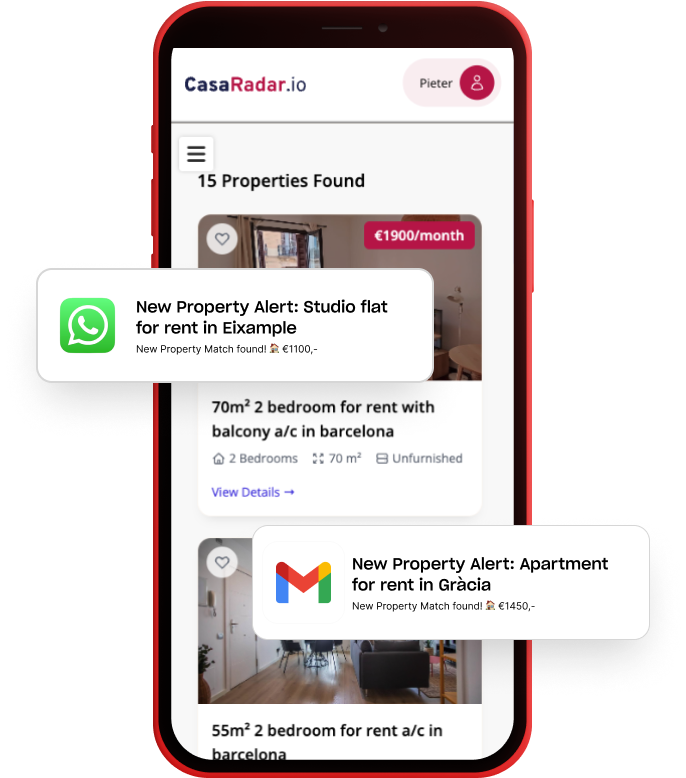
Where Rental House Listings Come to You
We track major and small real estate listing websites in Barcelona — so you don’t have to. Set your housing search criteria, and we’ll send you instant alerts the moment a new rental listing goes live that's fits your requirements.