

Barcelona Rent Prices in 2026: What to Expect Neighborhood by Neighborhood
Let me be direct: renting in Barcelona has become expensive.
A decade ago, you could find a 1-bedroom apartment in a nice neighborhood for €700. Today, that same apartment costs €1,400-1,600. A single room that used to rent for €300 now costs €500-700.
If you're moving to Barcelona in 2026, understanding current rent prices is essential. You need realistic expectations before you start apartment hunting.
This guide breaks down exactly what you'll pay in Barcelona's main neighborhoods, what affects prices, and how to navigate an increasingly competitive rental market.
The Big Picture: Barcelona Rent in 2026
Overall average rent: €1,550-1,650/month for a 1-bedroom apartment
This represents a 35-40% increase from 2020 and a 15-20% increase from 2024.
Average room prices: €450-650/month for a single room in a shared apartment
The increase for rooms has been similar—rooms that rented for €300-350 in 2021 now cost €500+.
Why the spike?
- Massive influx of international residents (digital nomads, expats, students)
- Tourism recovery pushing demand for furnished short-term rentals
- Limited new housing construction
- Investment companies buying up residential properties
- Inflation and general cost-of-living increases
- Remote work making Barcelona attractive to high-earning Europeans and Americans
The market is competitive. Good apartments in popular neighborhoods get 20-50 inquiries within the first day. Slow neighborhoods still move fast.
Rent Prices by Neighborhood
Barcelona's neighborhoods vary wildly in price. Here's what you'll actually pay in 2026:
EXPENSIVE NEIGHBORHOODS (€1,600-2,200/month for 1-bed apartment)
Eixample (The Most Popular Neighborhood)
Eixample is Barcelona's largest neighborhood—the grid-pattern area designed by Eixample Cerda with tree-lined streets, wide sidewalks, and architectural elegance.
1-bedroom apartment: €1,600-1,900/month
Single room: €550-700/month
Entire flat (2-bed): €2,200-2,800/month
Why it's expensive:
- Proximity to everything (metro, restaurants, shops, business district)
- Beautiful architecture and safe streets
- Popular with professionals and digital nomads
- Great for nightlife, culture, dining
- Excellent public transportation
Best for: Professionals, students who want walkability, people prioritizing convenience over character
Drawback: Can feel commercial; less local Barcelona feel than other neighborhoods
Recommended streets: Passeig de Sant Joan (more expensive, prettier), Carrer de Còrsega, Carrer de Provença
Sarrià (Wealthier, Quieter)
Sarrià is an upscale neighborhood in the upper part of Barcelona, more residential and prosperous than central areas.
1-bedroom apartment: €1,700-2,100/month
Single room: €600-800/month
Entire flat (2-bed): €2,400-3,000+/month
Why it's expensive:
- Wealthy neighborhood (more affluent residents)
- Quieter, more residential feel
- Better for families and those wanting less urban intensity
- Less touristy than Eixample
- Good schools and parks nearby
Best for: Families, people who work from home, those seeking calm away from city center
Drawback: Quieter means less social scene; more expensive; fewer bars/clubs
Neighborhood character: Upscale, residential, quieter Barcelona
Les Corts (Financial District)
Les Corts is Barcelona's business and financial hub, adjacent to Camp Nou (FC Barcelona stadium).
1-bedroom apartment: €1,550-1,900/month
Single room: €500-700/month
Entire flat (2-bed): €2,100-2,700/month
Why it's expensive:
- Business district (lots of office workers)
- Near Camp Nou stadium (attraction for football fans)
- Modern infrastructure
- Good metro connectivity
- More corporate, less bohemian
Best for: Business professionals, football fans, those working in corporate jobs
Drawback: Less character than artsy neighborhoods; more business-focused
Neighborhood character: Modern, efficient, corporate
MID-RANGE NEIGHBORHOODS (€1,300-1,600/month for 1-bed apartment)
Gràcia (Artistic, Young, Bohemian)
Gràcia feels like a separate village within Barcelona. It's the neighborhood for young people, artists, and those seeking authentic Barcelona culture rather than tourist attractions.
1-bedroom apartment: €1,400-1,700/month
Single room: €480-650/month
Entire flat (2-bed): €1,900-2,400/month
Why it's priced moderately:
- Farther from Plaça de Catalunya (Barcelona's center)
- Less touristy than central areas
- Still highly desirable (neighborhood culture)
- Good metro access
- Strong expat and international student community
Best for: Young people, artists, students, those wanting authentic Barcelona culture, social atmosphere
The vibe: Bohemian, artistic, international, vibrant nightlife, quirky character
Recommended streets: Verdi district, Plaça de la Virreina, Carrer de Verdi
Drawback: Can feel crowded despite neighborhood size; lots of noise in some areas
Poblenou (Regenerated Industrial, Hipster)
Poblenou was once Barcelona's industrial district. It's been regenerated into a trendy neighborhood with galleries, design studios, startups, and young professionals.
1-bedroom apartment: €1,350-1,650/month
Single room: €450-600/month
Entire flat (2-bed): €1,850-2,300/month
Why it's moderately priced:
- Still relatively new as a "desirable" neighborhood (less established)
- Farther from city center
- Beach access (Poblenou is near Barceloneta)
- Startup/creative community feel
Best for: Creatives, digital nomads, startups, those wanting beach proximity, younger demographic
The vibe: Trendy, artistic, creative, beach-adjacent, startup culture
Drawback: Can be unpredictable; some areas still industrial; less established infrastructure than central areas
Horta-Guinardó & Campingà (Affordable, Residential)
These are upper Barcelona neighborhoods, farther from the center. They're residential, primarily for local Barcelonans.
1-bedroom apartment: €1,100-1,400/month
Single room: €400-550/month
Entire flat (2-bed): €1,600-2,000/month
Why it's more affordable:
- Farther from city center
- Less touristy
- Primarily residential
- Younger/smaller metro system coverage
- Less nightlife and restaurant scene
Best for: Budget-conscious renters, those with a job in that area, families wanting quiet neighborhoods
Drawback: Longer commute to city center; fewer bars/restaurants; less cosmopolitan
Sant Antoni (Gentrified, Trendy)
Sant Antoni was once gritty and working-class. It's now rapidly gentrifying, with new bars, markets, and a younger crowd.
1-bedroom apartment: €1,450-1,750/month
Single room: €500-680/month
Entire flat (2-bed): €2,000-2,500/month
Why it's moderately expensive:
- Rapidly gentrifying (prices rising)
- Close to city center
- Emerging neighborhood vibe
- Good food scene and markets
Best for: Those wanting trendy neighborhood without Eixample's corporate feel, foodies
Neighborhood character: Gentrifying, trendy, mixed crowd
BUDGET-FRIENDLY NEIGHBORHOODS (€1,000-1,350/month for 1-bed apartment)
Raval (Diverse, Gritty, Artistic)
Raval is the inner-city neighborhood right next to the Old City. It's diverse, gritty, artistic, and increasingly international.
1-bedroom apartment: €1,200-1,500/month
Single room: €400-550/month
Entire flat (2-bed): €1,700-2,100/month
Why it's more affordable:
- Less polished; grittier feel
- Diverse population (not as "expat-friendly" as Gràcia)
- Some safety concerns in certain areas (though improving)
- Close to museums and Old City
Best for: Budget-conscious renters, those comfortable with gritty urban areas, artists
The vibe: Diverse, bohemian, gritty, artistic, changing rapidly
Drawback: Some areas feel unsafe at night; more petty crime; less polished infrastructure
Pro tip: Some blocks are much better than others. Research specific streets before committing.
Sants (Working-Class, Affordable)
Sants is an older, working-class Barcelona neighborhood. It's not trendy, but it's real, affordable, and has a genuine local community.
1-bedroom apartment: €1,100-1,400/month
Single room: €400-550/month
Entire flat (2-bed): €1,600-2,000/month
Why it's affordable:
- Less desirable among expats and international crowd
- Working-class neighborhood (local Barcelona feel)
- Farther from city center
- Fewer bars/restaurants compared to central areas
- Less touristy
Best for: Budget-conscious renters, those wanting authentic Barcelona, people with a job in that area
The vibe: Working-class, local, authentic, less polished
Drawback: Less social scene; fewer bars/restaurants; less international community
Nouvelle Barcelona (Outer Areas)
Neighborhoods farther from the center—Cornellà, Granollers, Badalona—are significantly cheaper but require commutes to central Barcelona.
1-bedroom apartment: €850-1,200/month
Single room: €350-450/month
Trade-off: 30-45 minute metro commutes to central Barcelona. Not recommended unless you have a specific job in that area or budget is critical constraint.
Room vs. Full Apartment: The Price Difference
Single room in shared apartment: €450-700/month
- Cheapest option for solo renters
- Includes shared living space, kitchen, bathroom
- No personal common area
- Popular with students and budget travelers
Studio or 1-bedroom apartment: €1,200-1,900/month
- Private space with bedroom, kitchen, bathroom
- More expensive (5-7x cost of a room)
- More independence
- Popular with professionals and couples
2-bedroom apartment: €1,600-2,500+/month
- Per-person cost lower if roommate splits rent
- More space and separation
- Usually costs less per-person than two separate rooms
Key insight: If you need a private space and budget is tight, a studio is usually only 10-20% more expensive than a room, while giving you significantly more privacy and space.
What Affects Barcelona Rent Prices
Understanding these factors helps you negotiate and find better deals:
1. Proximity to City Center
Every 500 meters away from Plaça de Catalunya, rent drops 5-10%. Distance matters massively.
2. Metro Access
Apartments on metro lines rent for 10-15% more than those requiring buses or 10+ minute walks.
3. Neighborhood Reputation
Trendy neighborhoods (Poblenou, Gràcia, Sant Antoni) cost 10-20% more than equally convenient but less-known areas.
4. Amenities
- Terrace/balcony: +5-10%
- Air conditioning: +3-8%
- Washing machine: +5-7%
- Parking: +50-100 extra per month
5. Furnished vs. Unfurnished
- Furnished (common in tourist areas): 10-30% more expensive
- Unfurnished: Standard price
6. Building Age
- Pre-1970s charm: Premium pricing
- Modern (1980s-2000s): Standard pricing
- Recently renovated: Premium pricing
- Outdated/unrenovated: 10-20% cheaper
7. Season
- September-October (back-to-school, new academic year): Highest demand, highest prices
- June-August (summer, vacation): Lower demand, potentially more negotiating power
- November-January: Lower demand
8. Lease Length
- 6-month leases: 5-10% premium
- 12-month leases: Standard pricing
- 24+ month leases: 5-10% discount possible
Seasonal Trends: When to Search
Peak season (September-October):
- Most new listings (back-to-school, new academic year)
- Highest prices and most competition
- Expect to move quickly or miss opportunities
Summer (June-August):
- Fewer listings
- Lower prices (less demand)
- Some flexibility in negotiation
- Better for finding deals
Winter (November-January):
- Low demand
- More negotiating power
- Fewer listings to choose from
Tips for Getting Better Deals
1. Be Flexible on Move-In Date
"I can move next week" is more attractive to landlords than "I need a place in 3 months." Flexibility gives negotiating power.
2. Offer Longer Leases
A 12-month lease at €1,400 is often easier for landlords to accept than a 6-month lease, even at same price. Longer commitment = price flexibility.
3. Pay Upfront (If Safe)
If you feel confident about a landlord, offering to pay 2-3 months upfront sometimes yields a 5-10% discount. (Only do this after verification!)
4. Search Less Popular Neighborhoods
Raval, Sants, and upper neighborhoods are 15-30% cheaper than central areas with only slightly longer commutes.
5. Find Roommates
Renting a 2-bedroom and finding a roommate often costs less per person than renting a private room. A €1,900 2-bedroom split is €950/person.
6. Hunt During Off-Season
Searching in July or January gives more negotiating power than September.
7. Contact Directly
Many listings on Idealista and Fotocasa filter through agencies (who take 50% commission). If you can find the owner directly, there's sometimes room to negotiate agency fees away.
Price Trends: Where Are Prices Heading?
2024-2025: Prices rose 12-15%2025-2026: Prices rose 8-12% (slower growth)2026 forecast: Likely 5-8% growth (stabilizing)
Barcelona's rent increases are slowing. Prices have become so high that demand may actually decrease if they rise much further. This might mean:
- Slower price growth in coming years
- More negotiating power for renters
- Potential stabilization in 2027-2028
However: Population growth continues (immigration, remote workers), so prices likely won't drop significantly.
Reality Check: Expectations vs. What You'll Actually Pay
If you want: A private 1-bedroom in a pleasant, central, safe neighborhood with metro access
Realistic price: €1,400-1,700/month
If you're looking for: A room in a shared apartment, any neighborhood, basic standards
Realistic price: €500-700/month
If you're hoping for: A 2-bedroom in Eixample for €900
Reality: Doesn't exist. Budget €2,000-2,400 minimum.
The Bottom Line
Barcelona rents in 2026 are expensive compared to many European cities, but they're still cheaper than Madrid, London, or Paris. Here's what to expect:
- Average apartment: €1,550-1,650/month (1-bedroom)
- Average room: €500-650/month
- Central neighborhoods (Eixample, Les Corts, Sarrià): €1,600-2,100+
- Mid-range (Gràcia, Poblenou, Sant Antoni): €1,300-1,700
- Budget (Raval, Sants, outer areas): €1,000-1,350

Ready to Find Your Rental Place in Barcelona?
Frequently asked questions about 2026 rent prices in Barcelona
Here are answers to some of the most common questions we receive.
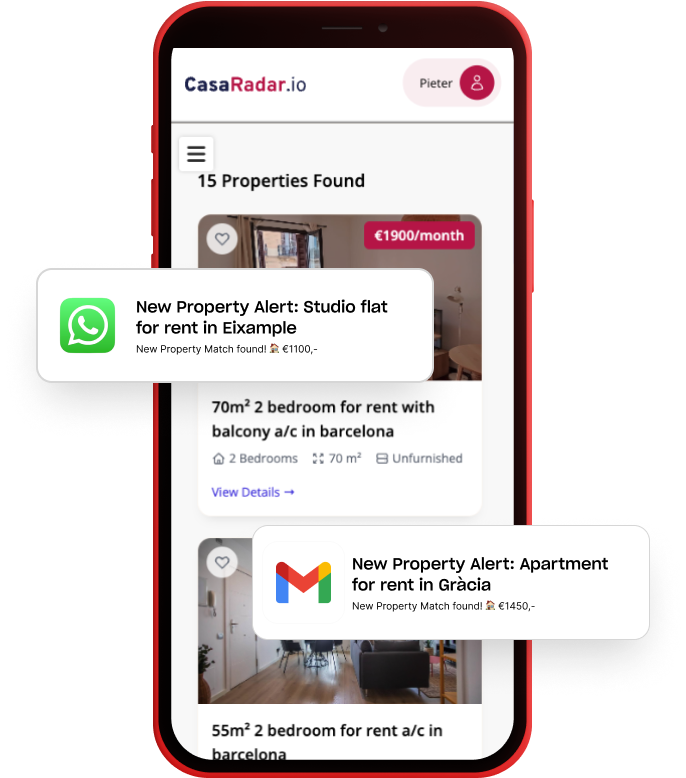
Where Rental House Listings Come to You
We track major and small real estate listing websites in Barcelona — so you don’t have to. Set your housing search criteria, and we’ll send you instant alerts the moment a new rental listing goes live that's fits your requirements.